

Your credit score may change as updated information is reported to the credit bureaus. However, there is no fixed schedule for when your score updates.
Credit card companies and other lenders generally report account information to the major credit bureaus at different times. Once new information appears on your credit report, your credit score may change when it is calculated using that updated data.
If you are wondering, “How often does my credit score update?”, the answer depends on when your lenders report information and when your credit report and score are accessed or calculated.
In this guide, you’ll learn how often credit scores change, whether your credit score can change daily, when credit bureaus update information, and what factors can cause your score to move.
Table of Contents
How Often Does Your Credit Score Update?
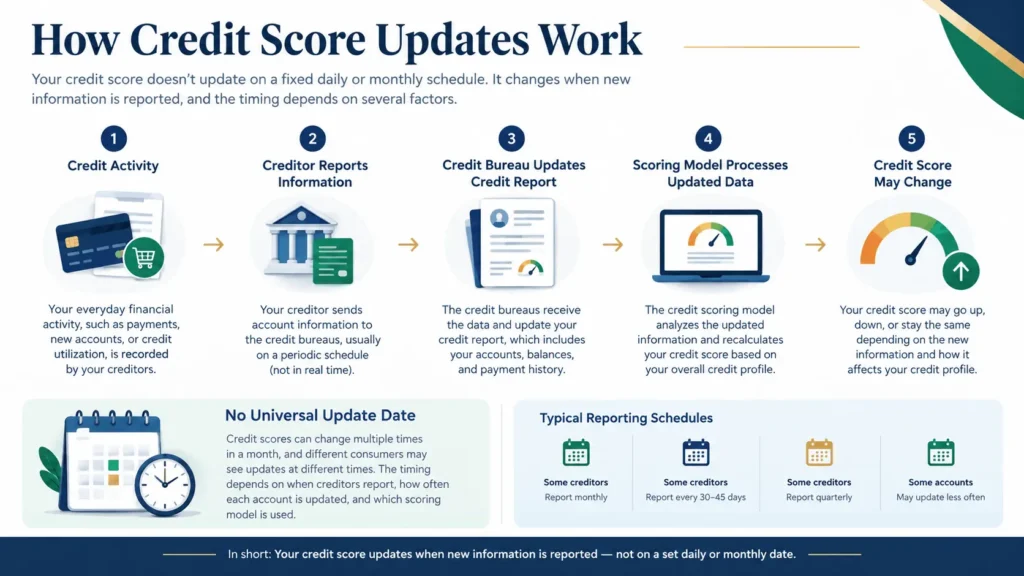
There is no single day when everyone’s credit score updates. Your score can change whenever new information is reported to your credit report and a scoring model calculates a score using that updated information.
Credit card issuers, lenders, and other companies may report information to the credit bureaus at different times. Because reporting schedules vary, your credit score could change several times during a month or remain unchanged for a period of time.
For this reason, checking your score on different days may show different results.
Does Your Credit Score Change Daily?
Your credit score can change frequently, but it does not necessarily change every day.
A score may change when new account information, payment history, credit balances, inquiries, or other reportable information is added or updated on your credit report.
If no new information is reported, your score may remain the same. Different lenders and credit card companies also have different reporting schedules, so there is no universal daily update time.
When Do Credit Bureaus Update Your Credit Information?
Credit bureaus update credit reports when companies that furnish information send new or revised account data.
Credit card issuers and lenders may report information at different times. For example, a credit card company may report your balance after a billing cycle or around the statement closing date.
Because each company can follow its own reporting schedule, there is no universal date when all credit reports are updated.
Once updated information appears on your credit report, it may affect your credit score depending on the type of information and the scoring model being used.
When Do Credit Scores Update?
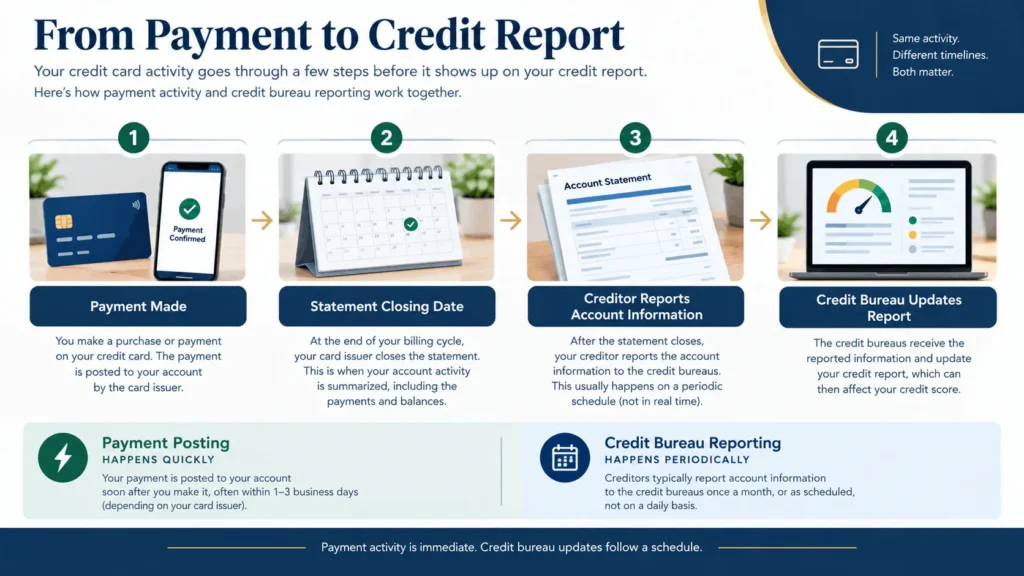
Credit scores do not have one universal monthly update date.A credit score is calculated from information in a credit report at a particular point in time. When information on that report changes, a newly calculated score may also be different.
For example, a recently reported credit card balance could change your credit utilization and potentially affect your score.
This is why your credit score may look different when you check it at different times.
What Causes Your Credit Score to Change?
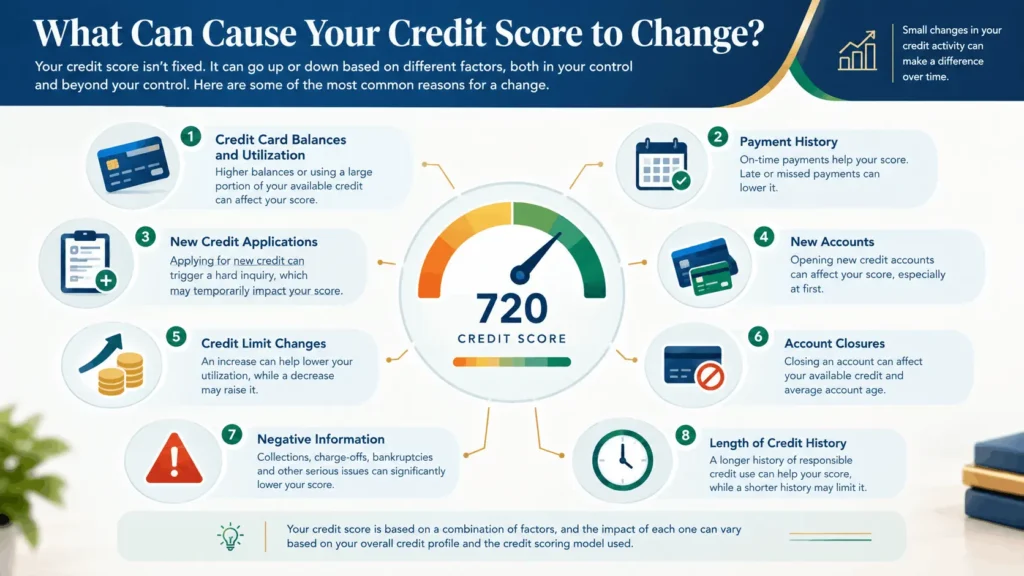
Your credit score can change when information in your credit report changes. Common factors include:
- Credit card balances and utilization: Higher or lower revolving balances can affect your credit utilization.
- Payment history: Late or missed payments can negatively affect your credit profile, while consistent on-time payments can support a stronger history.
- New credit applications: Applying for certain types of credit can result in a hard inquiry, which may affect your score.
- New accounts: Opening a new credit account can change the age and overall mix of your credit accounts.
- Changes to credit limits: A higher or lower credit limit can affect your overall credit utilization.
- Account closures: Closing an account can change your available credit and may affect other aspects of your credit profile.
- Negative information: New collection accounts, late payments, or other negative information may affect your credit score.
- Changes in credit history: As accounts age and information is updated, your credit profile can change over time.
Because credit scores are calculated from the information in your credit report, even a relatively small change can sometimes result in a different score.
Why Is My Credit Score Different Across Credit Bureaus?
It is normal for your credit scores from Equifax, Experian, and TransUnion to be different.
One reason is that creditors may not report information to all three credit bureaus at the same time. One bureau may receive an updated balance while another still has the previous information.
The information contained in your credit reports can also differ. A lender may report an account to one, two, or all three bureaus, and the timing of those updates may vary.
Another factor is the credit scoring model. Different scoring models can evaluate the information in your credit report differently. For example, a score from one model may not match a score calculated by another model, even when both use information from the same credit report.
For this reason, seeing different credit scores does not automatically mean that something is wrong with your credit.
How Often Should You Check Your Credit Score?
How often you check your credit score depends on your financial situation and goals. Regular monitoring can help you understand changes to your credit and spot potential problems sooner.
You may want to check your score more closely when preparing for a major financial decision, such as:
- Applying for a mortgage
- Financing a vehicle
- Applying for a new credit card
- Refinancing existing debt
- Preparing to make a major purchase
It is also useful to review your credit reports regularly for inaccurate or unfamiliar information.
Checking your own credit score generally does not have the same effect as applying for newcredit.A personal credit checkis typically considered a soft inquiry and does not lower your credit score. By contrast, a lender’s hard inquiry when you apply for credit may affect your score.
Ways to Speed Up Your Credit Score Update
You cannot control exactly when a credit bureau updates your credit report, but you can take steps that may help recent financial changes appear sooner.
- Pay down revolving balances: Lower your credit card balances before the creditor reports them when possible. This may reduce your reported credit utilization.
- Make payments on time: Consistent, on-time payments help maintain a positive payment history.
- Avoid unnecessary new credit applications: Applying for new credit can result in hard inquiries and may affect your score.
- Check your credit reports: Look for inaccurate, outdated, or unfamiliar information that could affect your credit profile.
- Keep accounts in good standing: Managing your credit accounts responsibly can support a healthier credit history over time.
Keep in mind that there is no guaranteed way to make a credit score update immediately. Reporting schedules are controlled by creditors and can vary.
Does Checking Your Credit Score Lower It?
Checking your own credit score generally has no negative impact on your credit score. When you check your score for personal monitoring, it is generally considered a soft inquiry.
A hard inquiry is different. It can occur when you apply for certain types of credit and a lender reviews your credit as part of the application process. A hard inquiry may result in a temporary reduction in your credit score, depending on your overall credit profile.
You can therefore monitor your credit without worrying that checking your own score will hurt it.
Credit Score Update Frequency vs. Credit Report Updates
A credit report refresh does not necessarily mean your credit score has changed.
Your credit report contains information about your credit accounts, payment history, balances, inquiries, and other credit activity. Creditors periodically send updated information to the credit bureaus.
Your credit score is determined by the information in your credit report and the scoring model used. When your credit report receives new or updated information, the scoring model may calculate a different score.
However, an updated credit report does not always lead to a score change. For example, a creditor may update an account without the new information significantly changing the factors used by the scoring model.
This explains why your credit report may change without affecting your credit score—or why a seemingly minor update can sometimes lead to a score change.
Credit Report vs. Credit Score: What’s the Difference?
A credit report contains information about your credit accounts and payment history. Credit reporting companies collect and update this information when creditors and other data furnishers provide it.
A credit score is a number calculated using information from a credit report and a specific scoring model.This distinction is important because your credit report may be updated before you see a corresponding change in a particular credit score.Different scoring models can also produce different scores from the same credit report.
How Long Do Credit Changes Take to Appear?
The timing depends on the type of change, the creditor’s reporting schedule, and when the updated information reaches the credit bureaus. There is no universal timeline that fits every situation.
Recent Payment
Once you submit a payment, the creditor must process it before the updated account information can be reported. The updated payment or balance may then be reported to the credit bureaus during the creditor’s next reporting cycle.
Lower Credit Card Balance
Once the card issuer reports the updated balance, your credit report may show a lower amount. If this reduces your credit utilization ratio, your credit score could change when the new information is incorporated into the scoring model.
New Credit Account
A newly opened credit account may not be reflected on your credit reports immediately and can take some time to be reported. The timing depends on when the lender or creditor begins reporting the account.
Credit Limit Increase
A higher credit limit may not affect your credit report or score immediately. Once the new limit is reported, it could reduce your overall credit utilization if your balances remain unchanged.
Disputed Information
If you challenge incorrect information on your credit report, the review and correction process may take some time. The timeframe can vary based on the details of the dispute and the organizations involved.
Because reporting schedules differ, it is better to focus on responsible credit habits rather than expecting a specific update date. Regularly monitoring your credit can help you understand when changes appear and identify potential errors early.
How to Keep Your Credit Score Healthy
You cannot control exactly when your credit score updates, but you can manage the information that affects your credit profile.
Consider these habits:
- Pay bills on time.
- Keep credit card balances under control.
- Avoid unnecessary credit applications.
- Monitor your credit reports for inaccurate information.
- Maintain older accounts when appropriate.
Manage existing debts responsibly.Consistent credit management can help maintain a stronger credit profile over time.
Frequently Asked Questions About Credit Score Updates
How often does your credit score update?
Your credit score can update whenever new information is reported to your credit report. There is no fixed update schedule.
Does your credit score change every day?
No. Your score may change when new information is reported, but it can also stay the same.
How often does your credit score change?
Your credit score can change whenever relevant information on your credit report is updated.
When do credit bureaus update?
Credit bureaus update reports when lenders and other data providers send new information. Timing varies by company.
When do credit scores update?
Credit scores can update when new information is reported and used in a score calculation. There is no specific update day.
When will my credit score update after a payment?
Your score may change after the lender reports the payment to the credit bureaus. The timing varies by creditor.
How often does Credit Karma update your credit score?
Credit Karma updates displayed information when its underlying credit-report data is refreshed. Updates may not appear immediately.
How often is a FICO score updated?
A FICO Score can change when the information used to calculate it changes. There is no fixed update schedule.
Can my credit score change without a new credit card or loan?
Yes. Changes to existing accounts, balances, payment history, or credit limits can affect your score.
Key Takeaway
Credit scores do not follow a set update date that applies to everyone. Creditors and lenders generally report account information to the credit bureaus periodically, but the timing can vary by creditor, account, and reporting cycle. When new information is reported to your credit file, the scoring model may reassess the updated data and generate a new credit score.
Changes such as a new credit card balance, recent payment, new account, credit limit adjustment, or hard inquiry can affect your credit profile. However, an update to your credit report does not always result in an immediate change to your score. The outcome depends on the information reported, your overall credit history, and the scoring model being used.
For this reason, consumers should not rely on a specific day of the month for a credit score update. Instead, focus on the factors you can control: make payments on time, keep credit card balances at manageable levels, limit unnecessary credit applications, and maintain established accounts responsibly. Regularly reviewing your credit reports can also help you identify inaccurate or unfamiliar information that may need attention.
Understanding how credit reporting and scoring work can make it easier to interpret changes in your credit score and prepare for important financial decisions, including applying for a mortgage, auto loan, or new credit card. A consistent approach to credit management is generally more valuable than trying to predict the exact date your score will change.