
Buying a home is a significant financial decision, and your credit score can influence your mortgage options, interest rate, and overall borrowing costs.
So, what is the best credit score to buy a house? There is no single score that guarantees approval. Some borrowers may qualify with scores around 620, while a score of 740 or higher may place you in a stronger position to secure competitive mortgage terms.
Your credit score is only one part of the application. Lenders may also consider your income, debt, down payment, employment, credit history, and other financial factors.
Table of Contents
What Credit Score Do You Need to Buy a House?
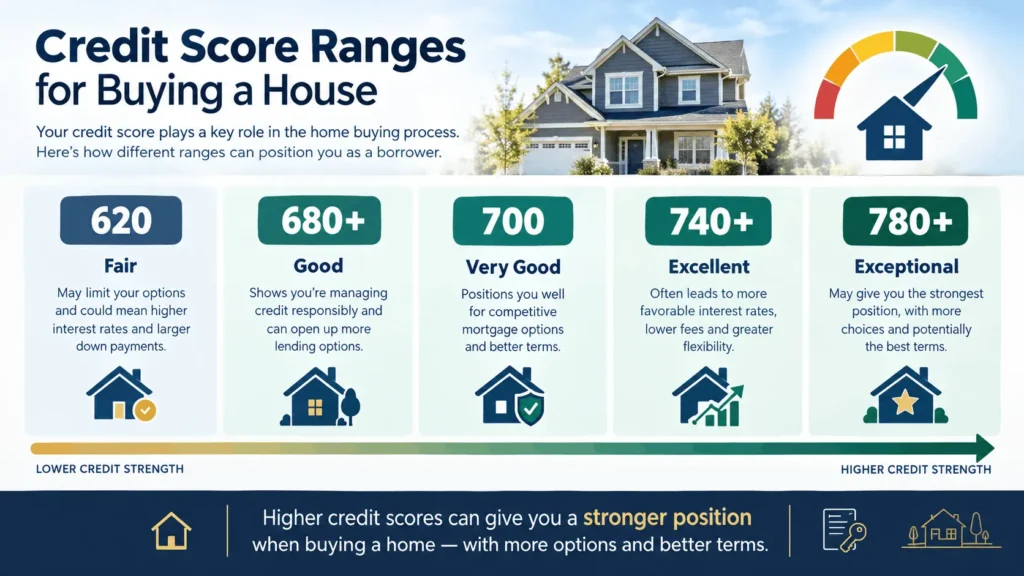
The credit score needed depends on the mortgage program and lender. Generally:
- 620: Common benchmark for some conventional mortgages.
- 680+: May provide stronger mortgage options.
- 740+: Very good credit that may qualify for more competitive pricing.
- 780+: Excellent credit that may support highly competitive terms.
The Consumer Financial Protection Bureau (CFPB) notes that borrowers with scores in the mid-to-high 700s or above generally receive the lowest mortgage rates, while scores below 620 can make qualifying more difficult.
Still, credit score should not be considered alone. Income, debt, down payment, and overall financial strength can significantly affect a lender’s decision.
Best Credit Score by Mortgage Type
Mortgage programs have different eligibility standards, so understanding the main loan types can help you determine where your credit score fits.
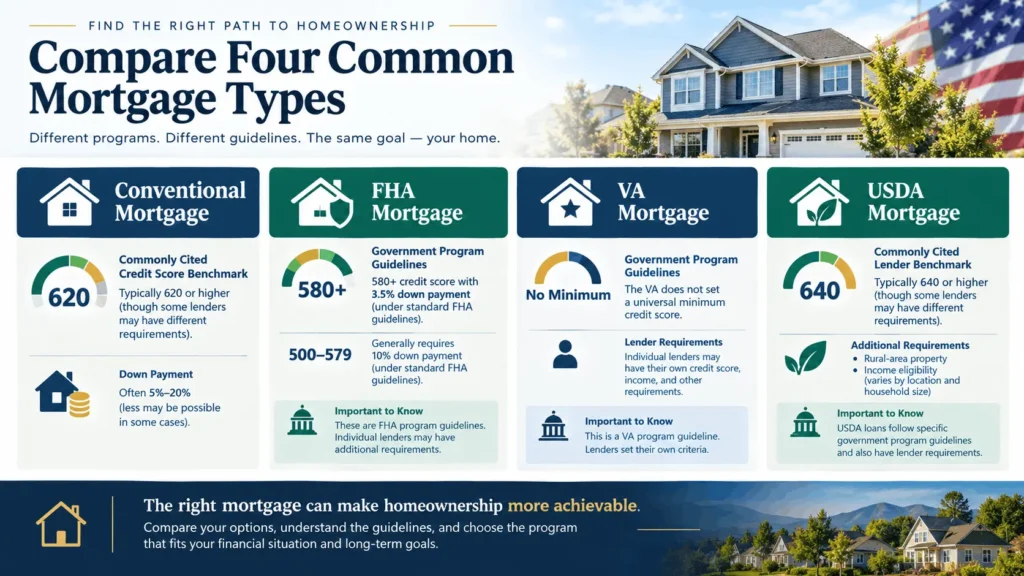
Conventional Mortgage
Conventional loans are offered by banks, credit unions, and mortgage lenders and are not insured by the federal government.
A 620 score is commonly used as a benchmark, although requirements vary by lender and borrower. Lenders may also evaluate:
- Income and employment
- Debt-to-income ratio
- Down payment
- Credit history
- Existing debts
- Loan amount
- Property type
Meeting a 620 benchmark does not guarantee approval or a specific interest rate.
FHA Loan
FHA loans are insured by the Federal Housing Administration and may be available to borrowers with lower credit scores.
Under standard FHA guidelines:
- 580+: Generally eligible for the 3.5% minimum down payment.
- 500–579: Generally requires a 10% down payment.
These are program guidelines, not guarantees of lender approval. Some lenders may impose additional requirements.
VA Loan
VA loans are available to eligible veterans, active-duty service members, and certain surviving spouses.
The Department of Veterans Affairs does not set one universal minimum credit score for all VA loans. Individual lenders may establish their own requirements and will also consider income, debts, employment, and other financial factors.
USDA Loan
USDA loans help eligible borrowers purchase homes in qualifying rural areas and include income and property requirements.
A 640 score is commonly associated with automated underwriting or certain streamlined USDA processes, but it is not a universal minimum for every borrower.
Eligibility can also depend on the property’s location, household income, credit history, debt obligations, and ability to repay.
Is a 620 Credit Score Enough to Buy a House?
A 620 credit score may be sufficient for certain mortgages, including some conventional loans, but it does not guarantee approval.
If your score is around 620, consider:
1. Checking your credit reports for errors.
2. Paying bills on time.
3. Reducing high credit card balances.
4. Avoiding unnecessary new credit applications.
5. Reviewing your debt-to-income ratio.
6. Saving for your down payment and closing costs.
7. Comparing offers from multiple lenders.
Shopping around can help you find mortgage terms that fit your financial situation.
Is 700 a Good Credit Score to Buy a House?
Yes. A 700 credit score is generally considered good credit and may put you in a stronger position than a borrower near the minimum qualifying range.
However, your score alone does not determine mortgage approval or your interest rate. Lenders may also consider your debt-to-income ratio, income, down payment, loan amount, and other financial details.
A strong credit profile combined with manageable debt, stable income, and an appropriate down payment can improve your position when comparing mortgage options.
The most important step is to understand your overall financial position before applying for a mortgage. Strengthening your credit, reducing debt, building your down payment, and comparing lenders can help you make a more informed home-buying decision.
Is a 740 or 780 Credit Score Better for a Mortgage?
Both 740 and 780 are strong credit scores. However, a 780 score may provide an advantage in some mortgage pricing models because stronger credit can indicate lower lending risk.
Still, a 780 score does not guarantee a lower interest rate than a 740 score. Mortgage pricing also depends on the loan program, loan amount, down payment, property type, lender, and current market conditions.
740 Credit Score
A 740 credit score is generally considered very good and can place you in a strong position when applying for a mortgage.
However, your credit score is only one part of the application. Income, debt, down payment, loan characteristics, and other financial factors can influence the mortgage terms you receive.
780 Credit Score
A 780 credit score represents an even stronger credit profile and may help you qualify for competitive mortgage pricing, depending on the lender and loan details.
However, there is no universal rule that a 780 score guarantees the lowest available rate. Once your credit is already strong, other factors can have a meaningful impact on your mortgage offer.
The bottom line: Both scores are excellent for mortgage purposes. Rather than focusing on a single target score, maintain healthy credit and compare offers from multiple lenders.
What Else Do Mortgage Lenders Consider?

Your credit score is important, but lenders evaluate much more than your score when reviewing a mortgage application. They may consider your income, debts, credit history, down payment, property, and other financial information.
Debt-to-Income Ratio
Your debt-to-income ratio (DTI) measures your monthly debt payments relative to your gross monthly income.
For example, if you earn $6,000 per month before taxes and have $2,400 in qualifying monthly debt payments, your DTI is 40%.
A lower DTI generally means more of your income remains available for housing costs. DTI requirements can vary by lender and loan program.
Down Payment
The down payment amount directly influences the amount you need to finance.
A larger down payment can reduce the principal balance and may lower your overall mortgage costs. However, you should also keep enough savings for closing costs, moving expenses, emergencies, and other homeownership needs.
Income and Employment History
Lenders generally want to verify that you have sufficient and reliable income to support your mortgage payments.
They may review your income sources, employment history, and supporting financial documents. Requirements can vary based on your circumstances and the mortgage program.
A strong credit score alone does not demonstrate your ability to repay the loan.
Credit History and Payment History
Mortgage lenders may evaluate your credit history alongside your credit score when assessing your loan application.
They can consider payment patterns, outstanding accounts, recent credit activity, and other information reported on your credit reports. Consistent on-time payments and responsible credit management can support a stronger credit profile.
Existing Debts
Your current financial obligations can influence how much you may be able to borrow.
Credit cards, auto loans, student loans, personal loans, and other debts may be included in the lender’s assessment. Reducing unnecessary debt before applying may strengthen your overall financial position.
Loan Amount and Property Type
The amount you borrow and the type of property you purchase can affect mortgage requirements and pricing.
For example, requirements may differ depending on the property and loan structure. Therefore, a particular credit score cannot guarantee approval or a specific mortgage rate.
Ways to Improve Your Credit Score Before Buying a Home

You don’t need perfect credit to buy a home. Instead, focus on strengthening your overall credit profile and addressing issues that could affect your mortgage application.
Pay Every Bill on Time
Your payment history is a key factor in determining the strength of your overall credit profile. Use payment reminders or automatic payments when helpful, and make timely payments a priority.
Reduce Credit Card Balances
High revolving balances can increase your credit utilization and potentially affect your credit scores.
Paying down credit card balances before applying for a mortgage may strengthen your credit profile while also reducing interest costs.
Check Your Credit Reports for Errors
Review your credit reports before applying and look for potentially inaccurate information, such as:
- Accounts you do not recognize
- Incorrect payment history
- Inaccurate balances
- Incorrect personal information
- Duplicate accounts
If you identify an error, you can dispute inaccurate information with the appropriate credit reporting company or information provider.
Avoid Unnecessary New Credit
Opening multiple credit accounts shortly before applying for a mortgage can create unnecessary changes to your credit profile.
If you are preparing to buy a home, avoid new credit applications unless you have a legitimate financial need for the account.
Keep Older Accounts Open When Appropriate
Older credit accounts may contribute to the length of your credit history. However, keeping an account open is not always beneficial if it carries costly fees or encourages unnecessary spending.
Before closing an older account near the time of a mortgage application, consider how it could affect your credit utilization and overall profile.
Start Preparing Early
Improving your credit is easier when you begin before you need a mortgage.
Review your credit and finances several months before applying when possible. This gives you time to correct errors, lower balances, manage debt, and establish stronger financial habits.
Can You Buy a House With Bad Credit?
Buying a home with poor credit is still possible, but you may have fewer financing options and face higher interest rates and borrowing costs.
A credit score below 620 does not automatically prevent you from getting a mortgage. Some government-backed programs accept borrowers with lower scores.
For example, FHA-insured loans may be available to qualifying borrowers with scores as low as 500. However, borrowers with scores between 500 and 579 generally need a larger down payment than those with scores of 580 or higher. Individual lenders may also set stricter requirements, so meeting a program’s minimum score does not guarantee approval.
If your credit score is below 620, consider these options:
- FHA loans: May provide financing options for eligible borrowers with lower credit scores.
- Other government-backed loans: Depending on your circumstances, other programs may have different credit requirements.
- Specialized lender programs: Some lenders work with borrowers who have weaker credit, although rates, fees, and eligibility requirements can vary.
- Improving your credit first: If you can delay your purchase, raising your score may increase your loan options and potentially reduce borrowing costs.
Your credit score is just one of several factors lenders consider when evaluating a mortgage application.Lenders may also consider your income, debt, down payment, employment history, credit history, and overall financial position.
Even when you qualify with a lower score, improving your credit can be beneficial. A stronger credit profile can improve your chances of securing favorable loan terms and rates.
Before choosing a mortgage, compare offers from multiple lenders rather than accepting the first option available.
Credit Score vs. Mortgage Credit Score: What’s the Difference?
The credit score shown by a credit card provider, bank, or free credit-monitoring service may not be the same score a mortgage lender uses.
Mortgage lenders can use different credit-scoring models and versions depending on the loan and underwriting process. As a result, the score you see as a consumer may differ from the score used to evaluate your mortgage application.
Mortgage credit scoring is also changing in 2026. The Federal Housing Finance Agency (FHFA) says Fannie Mae and Freddie Mac are moving through an interim period in which approved lenders can use either Classic FICO or VantageScore 4.0 for loans sold to the Enterprises. FICO 10T has also been approved for future use as part of the industry’s credit-scoring modernization.
Fannie Mae’s 2026 guidance includes Classic FICO, VantageScore 4.0, and FICO 10T among the approved scoring models and explains how a representative credit score is determined for mortgage purposes.
Because mortgage scoring is evolving, do not assume the score you see online will be identical to the one used by your lender.
If you are planning to buy a home, ask your lender which credit reports and scoring models will be used to assess your application.
How to Prepare Your Credit for a Mortgage Application
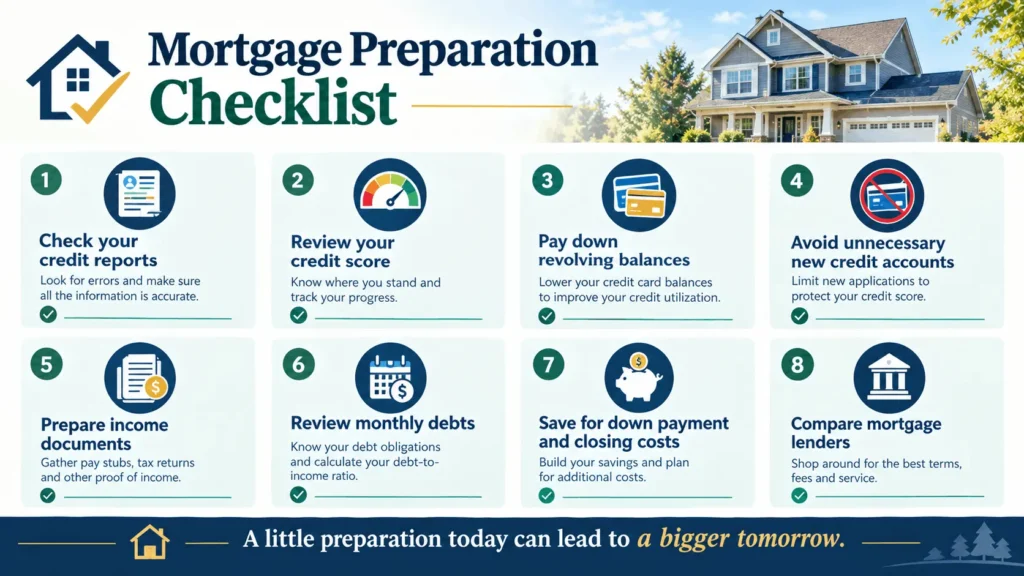
Taking steps to strengthen your finances before applying for a mortgage can support your application and help streamline the borrowing process.
Check Your Credit Reports
Check your credit reports for any inaccurate, outdated, or unfamiliar entries. Addressing errors before applying can help avoid unnecessary underwriting issues.
Review Your Credit Score
Understand your current credit position before contacting lenders. Keep in mind that your consumer score may differ from the score used for mortgage underwriting.
Pay Down Revolving Debt
Carrying large credit card balances can raise your credit utilization ratio and increase your monthly financial commitments. Reducing revolving debt may strengthen your credit profile and improve affordability.
Avoid Unnecessary New Credit
Avoid new credit applications before applying for a mortgage. New accounts can affect your credit profile and may require additional documentation or explanation.
Organize Your Income Documents
Prepare records showing your income and employment history. Having these documents available can help streamline the mortgage application process.
Review Your Monthly Debt
Calculate your existing monthly obligations, including credit cards, auto loans, student loans, personal loans, and other debts. Lenders use this information when assessing your ability to afford a mortgage.
Save for a Down Payment and Closing Costs
Budget beyond the monthly mortgage payment. You may also need funds for the down payment, closing costs, and other home-buying expenses.
Compare Mortgage Lenders
Shop around and compare lenders based on interest rates, fees, loan terms, and total borrowing costs. The first mortgage offer you receive may not be the most competitive.
Frequently Asked Questions About Mortgage Credit Scores
What Credit Score Do You Need to Buy a Home in 2026?
A 740+ credit score is generally considered strong and may help you qualify for competitive mortgage rates.
What Credit Score Do You Need for a Mortgage?
The required score varies by loan type. Conventional loans often require around 620, while some FHA loans accept lower scores.
Is a 700 Credit Score Strong Enough to Qualify for a Home Loan?
Yes. A 700 credit score can qualify you for several mortgage options, depending on your income, debts, and other factors.
Is 740 a Good Credit Score for Buying a Home?
Yes. A 740 credit score is considered strong and may help you secure competitive mortgage rates and terms.
What Credit Score Do You Need to Qualify for a Conventional Mortgage?
A 620 credit score is commonly the minimum for conventional mortgages, although requirements vary by lender.
Can You Buy a Home With a Low Credit Score?
Yes. You may be able to buy a house with bad credit, but you could have fewer loan options and higher borrowing costs.
Final Thoughts: Aim for Strong Credit Before Buying a Home
A perfect credit score is not required to qualify for a home purchase. A 620 credit score may be sufficient for some mortgage programs, while certain options may accept borrowers with lower scores.
A stronger credit profile can broaden your mortgage options and may help you secure more favorable loan terms. Lenders also consider factors such as income, debt, down payment, employment history, loan amount, and overall financial stability.
Before applying, review your credit reports, reduce unnecessary debt, organize your financial documents, and determine how much home you can comfortably afford.
Most importantly, compare mortgage offers from multiple lenders. Rather than focusing solely on reaching a specific credit-score target, consider the interest rate, fees, loan terms, and total cost of each mortgage offer.