

A better credit score can make it easier to qualify for credit cards, personal loans, auto loans, and other forms of financing. But improving your score does not always happen overnight.
In some cases, you may see an improvement within 30 days, especially if your credit card balances are high and you can lower them. However, there is no guaranteed number of points you can gain in one month. Your results depend on your current credit history, account balances, payment history, and other information in your credit reports.
The good news is that you can take several practical steps right now that may help your credit profile.
Table of Contents
Can You Really Increase Your Credit Score in 30 Days?
Yes, it is possible to see a credit score increase within 30 days, but it is not guaranteed for everyone.
One of the quickest areas to address is credit card utilization. If your cards are carrying high balances compared with their limits, paying those balances down before the issuer reports them may help your score once the updated information reaches the credit bureaus.
Other improvements, such as building a strong payment history or recovering from serious negative information, usually take longer.
What Can Improve Quickly and What Takes Longer?
Some credit-related changes can happen relatively quickly:
- Paying down high credit card balances
- Disputing incorrect details listed on your credit report
- Avoiding new hard inquiries
- Making all payments on time
Other factors generally take more time. For example, building a long history of on-time payments and recovering from major negative information cannot usually be accomplished in just a few weeks.
Why Your Starting Credit Profile Matters
Everyone starts from a different credit position. Someone with high credit card utilization may have an opportunity to improve relatively quickly by reducing balances. Someone with several recent late payments or a limited credit history may need more time.
Your credit score can also vary depending on the scoring model and the information available in your credit report. That is why you should focus on improving your overall credit profile rather than chasing a specific number of points.
Can Your Credit Score Improve Within 30 Days?
A 30-day improvement is possible, but the amount of change depends on your individual circumstances.
Credit scores are determined by the financial information reported in your credit history. Factors such as payment history, amounts owed, length of credit history, new credit, and credit mix can all play a role, depending on the scoring model being used.
When a Noticeable Improvement Is Possible
You may have a better chance of seeing a noticeable change when your credit card balances are high and you are able to pay them down.
For example, suppose you have a credit card with a $5,000 limit and a $4,000 balance. Your utilization on that card is 80%.
If you reduce the balance to $1,000, your utilization falls to 20%. Once the lower balance is reported to the credit bureaus, your score could improve.
However, the exact number of points is impossible to predict because credit scoring depends on your complete credit profile.
Why Credit-Score Changes Depend on Your Credit Profile
Credit scoring does not work the same way for every person. Two people who pay down the same amount of credit card debt could see different score changes.
The outcome can vary based on several factors, including:
- Your existing credit score
- Credit card utilization
- Payment history
- Age of your credit accounts
- Number of recent credit applications
- Total accounts and balances
- Negative information on your credit reports
For this reason, be cautious of companies that promise a specific number of points within a certain number of days.
How Quickly Do Creditors Typically Report Updated Information?
Credit card companies generally report account information to the credit bureaus periodically, often around the end of a billing cycle. Processing times may vary depending on the creditor.
This means paying down a balance does not necessarily cause your credit score to change immediately.
For example, if you pay your credit card today, the lower balance may not appear on your credit reports until the card issuer sends its next update. After the information is reported, the scoring model may reflect the change the next time your score is calculated.
Pay Down Your Credit Card Balances
Reducing credit card balances is one of the most practical steps you can take when trying to improve your credit score in a short period.
Credit card balances can affect your credit utilization ratio, which compares the amount of revolving credit you are using with your available credit limits.
How Credit Utilization Affects Your Score
Credit utilization is an important part of many credit-scoring models.
For example, imagine you have:
- Total credit limits: $10,000
- Total credit card balances: $6,000
Your utilization would be:
- $6,000 ÷ $10,000 × 100 = 60%
A 60% utilization rate is relatively high. Paying down some of that debt could lower your utilization and potentially improve your credit score after the updated balances are reported.
Why Lowering High Balances Can Help
High credit card balances can make it appear that you are using a large portion of your available revolving credit.
If you have enough money available to make an extra payment, reducing a high balance may help lower your utilization.
You do not necessarily have to pay off every card completely to make progress. Even reducing a large balance can lower your overall utilization.
However, never put essential expenses or emergency savings at risk just to chase a higher credit score.
Statement Balance vs. Current Balance
Understanding these two terms can help you manage your credit cards more effectively.
Current balance is generally the amount you currently owe on the account. It can change whenever you make purchases, payments, refunds, or other transactions.
Statement balance is the amount shown on your credit card statement at the end of a billing cycle.
What If You Are Already Behind on a Payment?
If you have missed a payment, don’t ignore it. Make the payment as soon as possible and contact your card issuer if you are having trouble catching up.
The longer a payment remains unpaid, the more serious the situation can become. If you are struggling to make payments, ask your lender whether they offer any hardship options or payment arrangements.
The amount reported to the credit bureaus can vary depending on when and how your card issuer reports account information. Paying down your balance before the statement closes may help reduce the balance that appears on your credit report.
Always check your card issuer’s terms and reporting schedule rather than assuming every lender reports on the same day.
Example: See How a $5,000 Payment Can Lower Your Credit Utilization
Suppose your credit card has:
- Credit limit: $5,000
- Current balance: $4,000
Your utilization is:
- $4,000 ÷ $5,000 × 100 = 80%
Now imagine you pay the balance down to $500.
Your new utilization would be:
- $500 ÷ $5,000 × 100 = 10%
That is a significant reduction in utilization.
After the card issuer updates the credit bureaus with the reduced balance, your credit score may improve. The amount of any change, however, can vary based on your overall credit history and the scoring formula used.
Keep Your Credit Utilization Low
Lowering your credit card balances is helpful, but keeping utilization low over time is even more important.
Credit utilization shows how much of your available revolving credit you’re using at a given time, expressed as a percentage.
What Is Credit Utilization?
You can work it out with the following straightforward formula:
- Credit Utilization Ratio = (Credit Card Balance ÷ Credit Limit) × 100
For instance, suppose your credit card has a $10,000 limit and you currently owe $2,000:
- 2,000 ÷ $10,000 × 100 = 20%
Your utilization is 20%.
For several credit cards, you can determine your total utilization by combining all your card balances and comparing them with your combined credit limits.
Why Keeping Balances Below 30% Is a Common Guideline
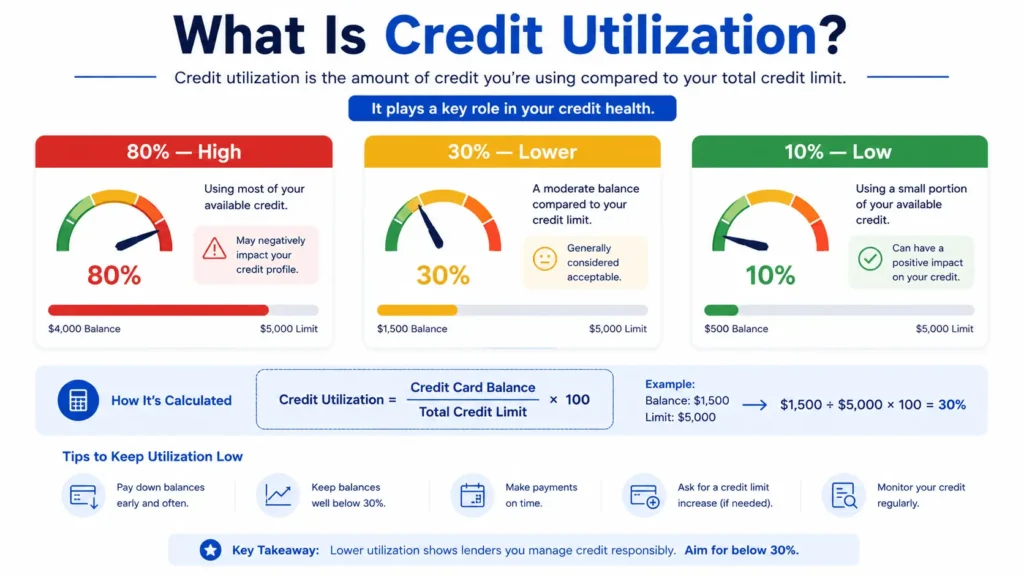
You’ve probably seen the common advice to keep your credit utilization under 30% of your available credit.
This is a helpful rule of thumb, but it should not be treated as a strict threshold. A lower utilization rate can generally be better for your credit profile, and people with strong scores often have relatively low revolving balances.
For example:
- $10,000 limit + $8,000 balance = 80% utilization
- A $10,000 credit limit with a $3,000 balance means you’re using 30% of your available credit.
- A $10,000 limit with just $1,000 owed brings your utilization down to 10%.
A smaller balance means you are using less of the credit available to you.
Why Lower Utilization May Be Better for Scoring
Credit scoring systems look at how much of your available revolving credit you’re currently using. Carrying a large balance compared with your credit limit may indicate a greater dependence on borrowed money.
If your budget allows, lowering your balances can help strengthen your credit profile once the updated amounts are reported to the credit bureaus.
The important thing is not to take on additional debt just to lower your credit utilization ratio. The goal should be to manage your existing credit responsibly while keeping your finances healthy.
Calculating Your Credit Utilization Ratio
Your credit utilization ratio measures the portion of your available revolving credit that you’re currently using. It’s an important factor in your credit profile, particularly when it comes to credit card accounts.
Use this simple formula:
Credit Utilization = (Credit Card Balance ÷ Total Credit Limit) × 100
For instance, imagine your credit card carries a $2,000 balance against a total credit limit of $5,000.
- $2,000 ÷ $5,000 × 100 = 40%
Your credit utilization would be 40%.
Keeping your credit utilization low can generally help maintain a stronger credit profile. If possible, try to keep your balances well below your total available credit. Reducing your credit card balances may improve your credit score after the lower amounts are reported to the credit bureaus.
Remember that utilization can be calculated for individual cards as well as across your total revolving credit limits.
Never Miss a Credit Card Payment Deadline
Your payment record plays a major role in determining your credit standing. Missing a payment or paying late may hurt your credit, especially when the late payment is reported to the credit bureaus.
The simplest way to protect your payment history is to make at least the required payment by the due date every month.
How to Avoid a Late Payment
Consider setting up autopay through your credit card issuer or bank. You can usually choose to automatically pay at least the minimum amount due.
You can also set calendar alerts or payment reminders several days before the due date.
Autopay can help prevent accidental missed payments, but you should still check your account regularly to make sure there is enough money available for the payment.
What If You Are Already Behind on a Payment?
If you have missed a payment, don’t ignore it. Make the payment as soon as possible and contact your card issuer if you are having trouble catching up.
The longer a payment remains unpaid, the more serious the situation can become. If you are struggling to make payments, ask your lender whether they offer any hardship options or payment arrangements.
Check Your Credit Reports for Errors
Credit report errors can make your credit profile look worse than it should. That’s why reviewing your credit reports is an important part of improving and maintaining your credit.
Common Credit Report Errors to Look For.
When reviewing your reports, check for things such as:
- Accounts that do not belong to you
- Incorrect account balances
- Wrong payment history
- Incorrect credit limits
- Accounts listed as late when you paid on time
- Duplicate accounts
- Incorrect personal information
Even a small error can be worth investigating if it affects your credit information.
If you’re looking for more ways to improve your credit, learn how to rebuild your credit with guidance from the CFPB.
How to Dispute Incorrect Information
If you find information that you believe is inaccurate, you can dispute it with the credit bureau reporting the information. You may also need to contact the company that provided the information.
Provide supporting documents when available and clearly explain what information you believe is incorrect.
After the dispute is investigated, the information may be corrected, updated, or removed if it cannot be verified.
Does Viewing Your Own Credit Report Affect Your Credit Score?
No. Checking your own credit report is generally considered a soft inquiry and does not lower your credit score.
Regularly reviewing your credit reports can help you identify errors or unfamiliar accounts before they become bigger problems.
Avoid Applying for New Credit
Applying for new credit can result in a hard inquiry when a lender checks your credit as part of an application. A hard inquiry can cause a small, temporary decrease in your credit score.
This doesn’t mean you need to avoid applying for credit altogether. However, applying for several new accounts within a short period can make managing your finances more difficult and may result in multiple hard inquiries.
Why Multiple Credit Applications May Be Risky
Every application can create a hard inquiry, depending on the lender and type of credit. Multiple applications can also increase your total amount of new credit.
If you are trying to improve your credit over the next 30 days, it may be better to avoid unnecessary applications.
When Applying for New Credit May Still Make Sense
Sometimes applying for new credit is necessary. For example, you may need a credit card for an emergency, a car loan, or another important financial need.
Don’t avoid necessary credit simply because of a possible hard inquiry. Instead, compare your options carefully and apply only when the new account makes financial sense.
Ask About Increasing Your Credit Limit
A higher credit limit can potentially lower your credit utilization ratio, as long as your spending does not increase.
For example, suppose you have a $2,000 balance on a card with a $5,000 limit. Your utilization is 40%.
If the limit increases to $10,000 while your balance stays at $2,000, your utilization falls to 20%.
When a Credit-Limit Increase May Help
A credit-limit increase may help if you already manage your account responsibly and can keep your spending under control.
Before requesting an increase, check whether your card issuer requires a credit check. Some issuers may use a hard inquiry, while others may not.
Don’t Increase Your Spending
A higher credit limit only helps your utilization if your balance stays the same or grows more slowly than your available credit.
Don’t treat a larger credit limit as extra money to spend.
If increasing your limit causes you to take on more debt, it could work against your goal of improving your credit.
Keep Older Credit Accounts Open When Appropriate
Older credit accounts can contribute to the overall history of your credit profile. For this reason, closing an old credit card is not always the best choice.
An older account may also contribute to your total available credit, which can affect your overall utilization.
However, this does not mean you should keep every account open forever.
Situations Where Closing a Credit Card Could Be a Smart Choice
Closing an account might make sense if it has expensive fees, creates financial problems, or you have another good reason to stop using it.
Before closing a card, consider how the decision could affect your available credit and overall credit profile.
If the account has no annual fee and you can manage it responsibly, keeping it open may be worth considering.
How Much Can Your Credit Score Increase in 30 Days?
There is no guaranteed number of points your credit score will increase in 30 days.
Credit scores are calculated using information in your credit reports, and different people can see very different results from the same actions.
For example, someone with high credit card utilization may see a noticeable improvement after paying down their balances and having the lower balances reported.
Someone with serious late payments or other negative information may take much longer to see significant improvement.
Factors That Influence How Quickly Your Score Changes
Your results can depend on:
- Your current credit score
- Credit card utilization
- Payment history
- Existing negative information
- Recent credit applications
- How quickly creditors report updated information
- The scoring model being used
Some improvements can appear relatively quickly, while building a stronger credit history usually takes much longer.
The goal should not be to chase a specific number of points in 30 days. Instead, focus on actions that improve your credit profile over time.
What Can Hurt Your Credit Score During These 30 Days?
While working on your credit, avoid actions that could create new problems.
Missing Payments
A missed payment can damage your payment history. Make payments on time and consider autopay or reminders to avoid accidentally missing a due date.
Maxing Out Credit Cards
Using most or all of your available credit can push your utilization ratio higher. If possible, pay down balances and avoid unnecessary new charges.
Applying for Several New Accounts
Multiple credit applications can result in multiple hard inquiries and may add new debt to your financial situation.
Closing Accounts Unnecessarily
Closing a credit card can reduce your available credit and potentially increase your overall utilization if you carry balances on other cards.
Ignoring Credit Report Errors
If inaccurate information appears on your credit reports, don’t simply ignore it. Review the information carefully and dispute errors when appropriate.
How Soon Can You Expect Credit Score Changes to Show Up?
Credit score changes usually do not happen instantly. Even after you make a payment or lower a credit card balance, you may need to wait for the information to be reported to the credit bureaus before your score reflects the change.
When Do Credit Card Companies Report Balances?
Credit card companies generally report account information to the major credit bureaus on a regular schedule, often around the end of a billing cycle. However, the exact reporting date can vary by lender.
For example, you could pay down your credit card balance today, but the lower balance may not appear on your credit report until your card issuer sends its next update.
This is why the timing of your payment can sometimes matter when you are trying to lower your reported credit utilization.
Why Your Credit Score Might Take Time to Update
Several factors can affect how quickly you see a change in your score:
- Your credit card company has not reported the new balance yet.
- The credit bureau has not processed the updated information.
- Your other accounts have also changed.
- Your credit utilization is still relatively high.
- Your credit report contains other factors affecting your score.
- Different credit scoring models may calculate your score differently.
A lower credit card balance can help your credit profile, but it does not guarantee an immediate increase in your score.
What If Your Updated Information Has Not Appeared?
If you recently paid down a balance or corrected information on your account, give the creditor enough time to report the change. Review your credit report once the next reporting period has passed.
If the information still appears incorrect, contact the creditor that reported it and consider filing a dispute with the appropriate credit bureau.
Keep records of payments, account statements, and dispute communications. These records can be useful if you need to follow up later.
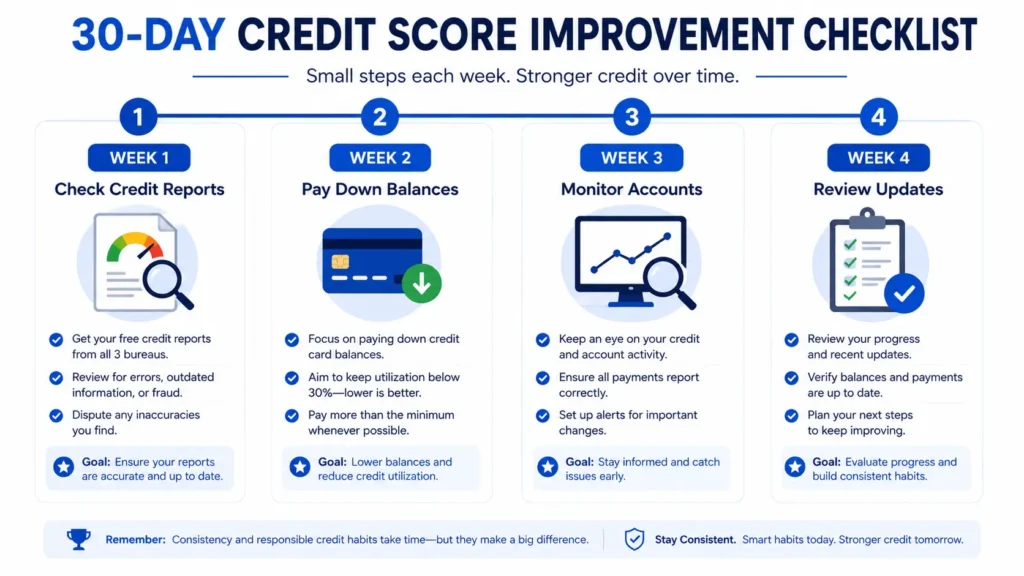
30-Day Credit Score Improvement Checklist
A 30-day plan can help you organize the actions that may improve your credit profile. However, there is no guarantee that your score will increase by a specific number of points during this period.
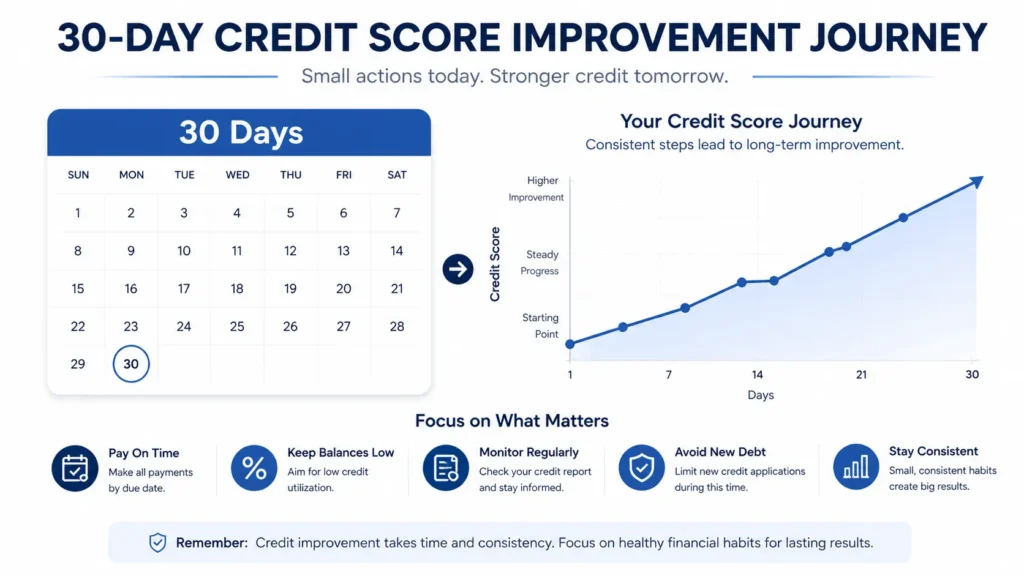
Week 1: Check and Prepare
Start by understanding your current credit situation.
- Check your credit reports for inaccurate or unfamiliar information.
- Review your current credit card balances and limits.
- Look for possible errors, such as incorrect balances or accounts you do not recognize.
- Set up payment reminders or autopay to help avoid missed payments.
The goal during the first week is to identify problems and create a plan before making major changes.
Week 2: Lower Your Balances and Avoid New Debt
Once you know where you stand, focus on reducing unnecessary credit card debt.
- Pay down high credit card balances if you can afford to do so.
- Ask your credit card issuer whether you qualify for a higher credit limit, but only if you can manage the account responsibly.
- Avoid unnecessary applications for new credit.
Lowering your credit card balances can reduce your reported credit utilization, which may help your score once the new balances are reported.
Do not increase your spending simply because you receive a higher credit limit. A larger limit only helps if you keep your balances under control.
Week 3: Monitor Your Accounts
During the third week, make sure the changes you made are actually being reflected in your accounts.
- Monitor your credit card accounts.
- Confirm that recent payments have posted successfully.
- Check the status of any credit report disputes.
- Watch for new or unexpected activity on your accounts.
Remember that a payment showing as completed on your credit card account does not necessarily mean the credit bureaus have already received the updated information.
Week 4: Review Your Progress
At the end of the month, take another look at your credit profile.
- Review your updated credit card balances.
- Check whether the new information has been reported.
- Look for any remaining errors or incorrect information.
- Continue the habits that helped reduce your credit utilization.
- Keep making every payment on time.
You may see a noticeable change, a small change, or no immediate change at all. That does not necessarily mean your efforts were unsuccessful. Some improvements take longer to appear and may require several reporting cycles.
Frequently Asked Questions About Improving Your Credit Score
Can I increase my credit score in 30 days?
Yes. Paying down balances and making on-time payments may help.
What’s the Quickest Way to Boost Your Credit Score?
Lower your credit utilization and avoid missed payments.
How many points can I gain in 30 days?
There is no guaranteed increase; results vary by person.
Can Paying Down a Credit Card Improve Your Credit Score?
Yes. Reducing your card balance can lower your credit utilization and potentially boost your score.
What credit utilization is best?
Keeping utilization below 30% is a good target.
Will Checking My Credit Score Lower It?
No. Checking your own credit score is a soft inquiry and won’t negatively affect your score.
Can correcting credit report errors help?
Yes. Removing inaccurate negative information may improve your score.
Final Thoughts: Focus on the Changes You Can Control
Improving your credit score is usually a process rather than a quick fix. Some changes, such as lowering a high credit card balance, may be reflected relatively quickly after your lender reports the new information. Other improvements, such as building a strong payment history, can take much longer.
Instead of focusing only on how many points your score increases in 30 days, focus on the actions you can control.
Pay your bills on time, keep credit card balances manageable, avoid unnecessary credit applications, review your credit reports regularly, and correct inaccurate information when you find it.
These habits can help you build a healthier credit profile over time. A 30-day plan can be a useful starting point, but consistent financial habits are what matter most for long-term credit improvement.