
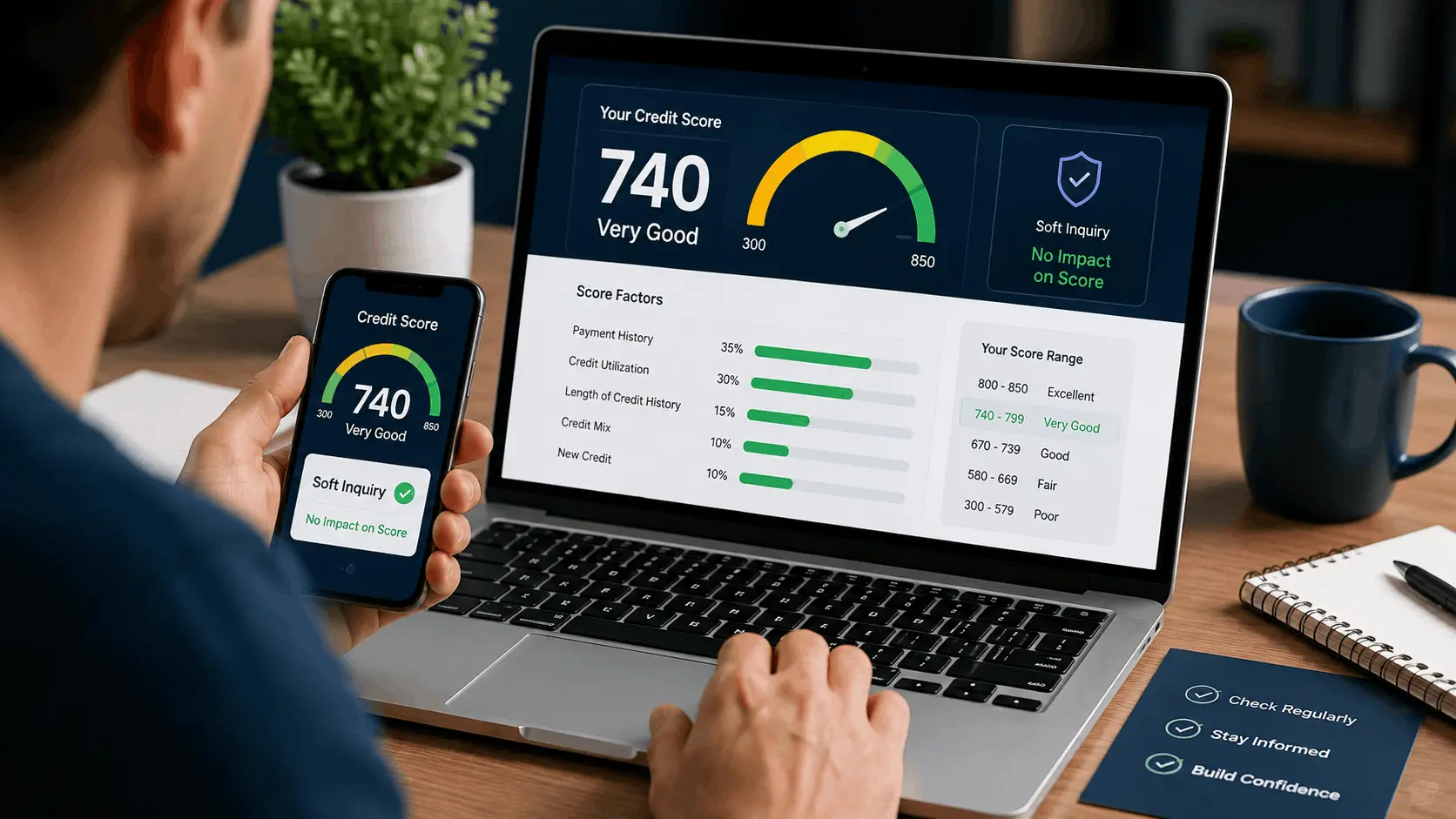
Keeping an eye on your credit score is a simple way to stay on top of your finances and understand where you stand financially. But if you have ever worried that checking your score could lower it, you are not alone.
The good news is that checking your own credit score generally does not lower your credit score. When you check your own score, it is usually considered a soft credit inquiry, which does not affect your credit score.
The confusion often comes from the difference between a soft inquiry and a hard inquiry. A hard inquiry can affect your score and usually happens when you apply for credit, such as a credit card, personal loan, or auto loan.
In this guide, you’ll learn how credit inquiries work and how to check your credit score without affecting it.
Table of Contents
Does Checking Your Credit Score Lower It?
Can Checking Your Credit Score Yourself Lower Your Credit Score?
No. Checking your own credit score does not normally hurt your credit score.
You can check your score to understand where you stand financially without worrying that the check itself will cause your score to drop.
For example, imagine your credit score is 710 and you check it today through your credit card account. That check is generally treated as a soft inquiry, so it should not lower your score.
Regularly checking your score can actually be a smart financial habit. It can help you notice changes, track your progress, and understand when you may be in a better position to apply for credit.
The important thing is to know how the score is being checked.
What is a soft credit inquiry?
A soft credit inquiry, also called a soft pull, happens when your credit information is checked for purposes that do not involve you applying for new credit.
Common examples include:
- Checking your own credit score
- Checking your own credit report
- Some credit card or bank credit monitoring services
- Certain prequalification or preapproval checks
- Some employment-related credit checks, where permitted
A soft credit check won’t cause your credit score to drop.
This means you can monitor your credit without feeling nervous that every check will cost you a few points.
What is a hard credit inquiry?
A hard credit inquiry, or hard pull, usually happens when you apply for new credit and a lender checks your credit as part of the application.
Examples can include applying for:
- A new credit card
- An auto loan
- A mortgage
- A personal loan
- Some other forms of new credit
Applying for new credit may cause your score to dip a little, but the effect is usually temporary. Multiple hard inquiries in a short period can also be a concern, especially when they result from several separate credit applications.
That is why it is important to avoid applying for new credit simply to see whether you qualify.
Soft inquiry vs. hard inquiry
A simple way to keep the difference in mind is:
- Soft inquiry = checking or monitoring credit without applying for new credit.
- Hard inquiry = a lender checking your credit because you applied for new credit.
| Soft Inquiry | Hard Inquiry |
|---|---|
| Checking your own credit score | Applying for a credit card |
| Credit monitoring | Applying for an auto loan |
| Some prequalification checks | Applying for a mortgage |
| Does not affect your score | May temporarily affect your score |
If you are simply checking your credit score to see where you stand, a soft inquiry is generally what you want.
Check Your Credit Score Without Impacting Your Credit
You do not need to avoid checking your credit score because you are afraid of lowering it. There are several convenient ways to monitor your score without creating a hard inquiry.
Check your credit score directly through your credit card provider
Many credit card companies provide free credit scores to their customers.
Log in to your credit card account or mobile app and look for a section such as Credit Score, Credit Monitoring, or FICO Score.
Depending on the issuer, the score may be updated regularly rather than every time you log in.
Before trusting the number, take a moment to check which credit scoring model and bureau provided it. The score you see may not be exactly the same score a lender uses.
Use a reputable free credit score service
Another option is to use a reputable credit monitoring or financial service that provides free credit score access.
Before signing up, understand what you are receiving. Some services provide an educational score rather than the exact score a particular lender may use.
Also pay attention to whether the service requires a paid membership or offers additional products.
The important point is that checking a score through a service designed for consumer credit monitoring generally uses a soft inquiry and does not lower your score.
Check your score through your bank or credit union
Your bank or credit union may also provide free credit score monitoring as part of its online banking or member benefits.
Sign in to your account and look for a credit score or credit monitoring section.
This can be a convenient option because you may already trust and use the financial institution.
As always, check the details to understand which credit score model is being shown and how often it is updated.
Review your credit report separately
Your credit score and credit report are two different things, even though they work closely together.
Your credit score is a number that summarizes information in your credit history. Your credit report contains the underlying information, such as credit accounts, payment history, balances, and other account details.
It is a good idea to review your credit report separately from checking your score.
When reviewing your report, look for:
- Accounts you do not recognize
- Incorrect personal information
- Incorrect account balances
- Late payments that could be reported incorrectly
- Accounts that should have been closed
- Signs of possible identitytheft
Checkingyourown credit report does not create a hard inquiry that lowers your credit score.
How to Check Your Credit Report for Free
Your credit report contains detailed information about your credit accounts, payment history, balances, and inquiries.Your credit score is a three-digit figure that reflects the information in your credit report.
For U.S. consumers, you can get free credit reports from the three major credit bureaus through the official federally authorized source, AnnualCreditReport.com.
Checking your credit report yourself does not count as a hard inquiry.
What Is the Difference Between a Credit Score and Credit Report?
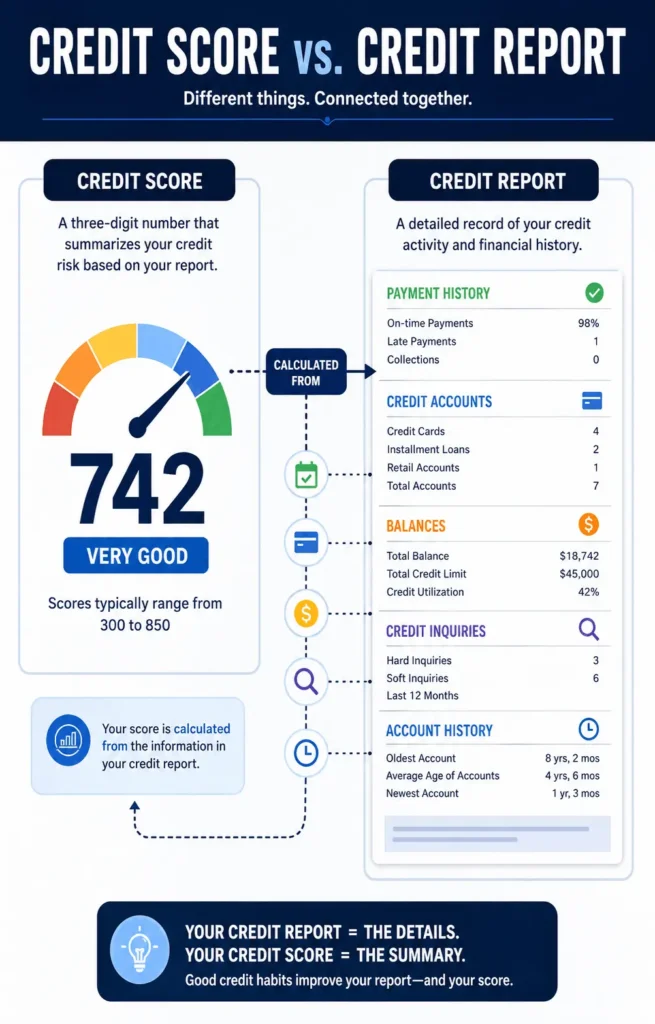
Think of your credit report as your credit history and your credit score as a number based on that history.
Your credit report can contain information such as:
- Credit cards and loans
- Payment history
- Account balances
- Credit limits
- Collections accounts
- Public-record information where applicable
- Companies that accessed your credit report
Your credit score summarizes information from your credit report into a number, commonly ranging from 300 to 850 for many consumer scoring models.
Because different lenders and scoring models may use different information, you may see slightly different credit scores from different sources.
When Should You Check Your Credit Report?
You can check your credit report regularly without hurting your credit score.
There is no need to avoid checking it because you are afraid that frequent checks will lower your score. In fact, reviewing your report can help you notice incorrect information, unfamiliar accounts, or suspicious activity earlier.
For many people, checking their reports several times a year is a useful habit. You may also want to check before applying for major credit.
What to Check When Reviewing Your Credit Report?
When reviewing your credit report, pay attention to:
- Accounts you do not recognize
- Incorrect payment history
- Wrong account balances
- Incorrect credit limits
- Accounts that should have been closed
- Duplicate accounts
- Incorrect personal information
- Hard inquiries you do not recognize
- Collections or other negative information that appears inaccurate
If something looks wrong, do not ignore it. An error on your credit report could potentially affect your ability to qualify for credit.
Soft vs. Hard Inquiries: What’s the Difference?
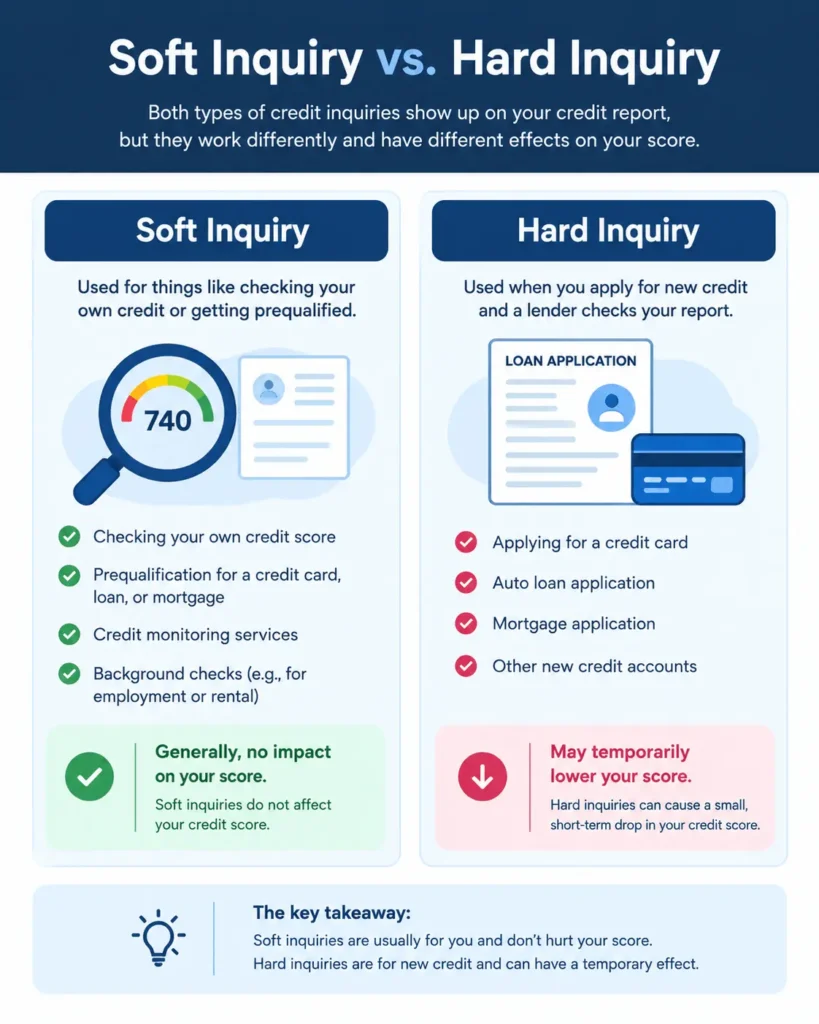
An easy way to keep the difference in mind is:
- Soft inquiry = checking credit without applying for new credit.
- Hard inquiry = a lender checking your credit as part of a credit application.
Soft Inquiries
A soft inquiry can happen when you check your own credit score or when a company checks your credit for certain purposes that do not involve a new credit application.
Examples may include:
- Checking your own credit score
- Some credit-monitoring services
- Certain prequalification or promotional credit checks
- Some employer background checks, where permitted
A soft inquiry typically has no effect on your credit score.
Hard Inquiries
A hard inquiry usually happens when you apply for new credit and give the lender permission to review your credit.
Examples include applications for:
- Auto loans
- Mortgages
- Some other types of credit
A hard inquiry may briefly lower your credit score by a few points.
One hard inquiry is usually not something to panic about. The bigger concern is applying for many new credit accounts in a short period.
When Does a Hard Inquiry Happen?
A hard inquiry generally happens when you actively apply for credit and the lender reviews your credit report as part of the application process.
For example, imagine you need a new car and apply for an auto loan. The lender may pull your credit report to help decide whether to approve the loan and what interest rate to offer you.
That credit check may be recorded as a hard inquiry.
By contrast, checking your own score before visiting the dealership does not turn your personal check into a hard inquiry.
How Long Will a Hard Inquiry Affect Your Credit Report?
Hard inquiries can remain on your credit report for up to two years, although their effect on your credit score is generally much shorter.
This is an important distinction: how long an inquiry appears on your report is not the same as how long it affects your score.
If you have one legitimate hard inquiry, there is usually no reason to panic. Focus on the factors that have a larger impact on your credit, such as making payments on time and managing your credit balances.
Does Checking Your Credit Score Multiple Times Hurt It?
No. Checking your own credit score multiple times generally does not hurt your credit score.
For example, suppose you check your score today, next week, and again next month. Those personal checks are generally soft inquiries and do not lower your score.
What can cause problems is repeatedly applying for new credit
Imagine you apply for five credit cards within a short period. Each application may result in a hard inquiry, and multiple new applications can also signal increased credit risk to lenders.
So remember:
- Checking your credit = generally safe
- Applying for lots of new credit = potentially harmful
These are two very different activities.
When Should You Check Your Credit Score?
There is no single perfect schedule for everyone. Your ideal frequency depends on your financial situation and whether you are preparing for a major credit application.
Monthly Monitoring
Checking your credit score about once a month can be helpful if you are actively working on improving your credit.
Regular monitoring can help you see whether your efforts are moving in the right direction.
You can also monitor your credit report for unexpected changes.
Before Applying for a Credit Card
Check your credit before applying for a new credit card.
Knowing your approximate credit standing can help you choose cards that better match your financial situation instead of applying randomly and collecting unnecessary hard inquiries.
Before Applying for a Loan
If you are planning to apply for an auto loan, personal loan, or mortgage, check your credit beforehand.
This gives you time to look for errors and understand where you stand before a lender performs a hard credit check.
After Paying Down Credit Card Balances
Paying off more of your card balance can help keep credit utilization low.
After giving your card issuer time to report the updated balance, checking your credit can help you see whether the lower balance has been reflected.
Do not expect your score to update immediately. Credit reporting depends on when your lender reports information to the credit bureaus.
When You Suspect Identity Theft or an Error
Check your credit report immediately if you notice something suspicious.
An unfamiliar credit card, loan, collection account, or hard inquiry could be a sign that something needs to be investigated.
Finding a problem early can give you more time to take action.
How to Check Your Credit Score Safely
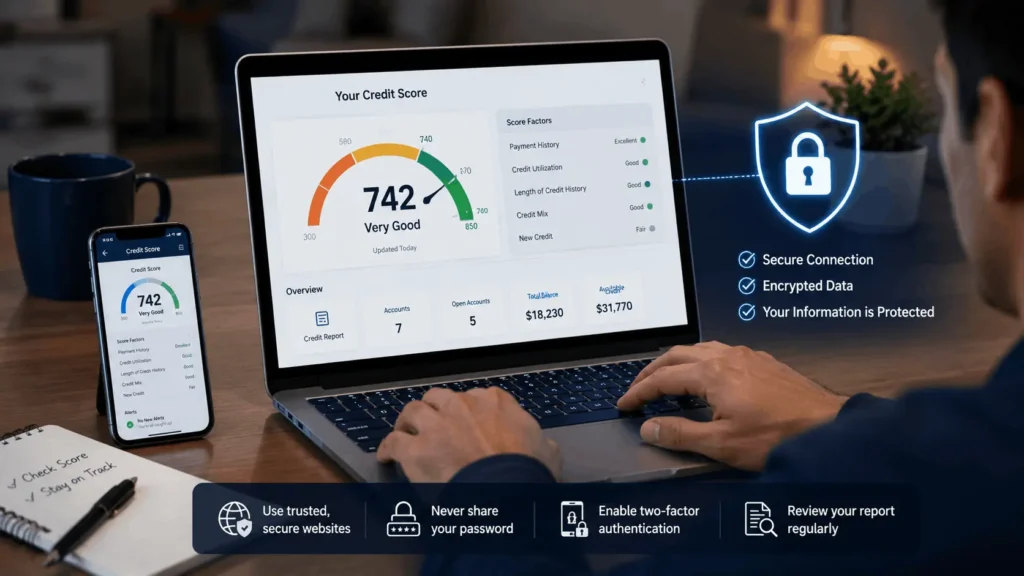
Not every website offering a free credit score deserves your trust. Be mindful of the websites and services you trust with your personal information.
Use Trusted Sources
Use reputable credit bureaus, financial institutions, or established credit-monitoring services.
For free credit reports, use the official AnnualCreditReport.com website rather than clicking on an unfamiliar advertisement promising a “100% free” report.
Be Cautious When Websites Request Sensitive Personal Details.
Your credit information is valuable.
Before entering sensitive information, make sure you understand who operates the website and why they need your information.
Be especially careful with websites that pressure you to provide information immediately or make promises that sound too good to be true.
Understand Whether a Service Uses a Soft or Hard Inquiry
Before using a credit-related service, look for information explaining whether checking your credit involves a soft or hard inquiry.
If you are simply monitoring your credit, you generally want a service that allows you to view your information without triggering a hard inquiry.
Don’t Confuse Credit Monitoring With a Credit Check by a Lender
Credit monitoring helps you watch your credit information for changes.
A lender’s credit check is different. When you apply for credit, the lender may perform a hard inquiry as part of its approval process.
Credit monitoring does not mean that every lender is automatically checking your credit.
What Can Actually Lower Your Credit Score?
Checking your own credit is generally not the problem. Other behaviors can have a much bigger effect.
Missing or Making Late Payments
Your payment history plays a major role in how many credit scoring systems calculate your credit score.
A missed or late payment can hurt your credit, particularly when it is reported as late to the credit bureaus.
The best habit is simple: pay your bills on time, every time.
If remembering due dates is difficult, consider automatic payments or calendar reminders.
Using Too Much of Your Available Credit
Credit utilization shows the percentage of your available revolving credit that you’re currently using.
For instance, suppose your credit card has a $5,000 limit and you’re carrying a $4,000 balance:
- 4,000 ÷ $5,000 × 100 = 80% utilization
That is a high utilization rate.
If the balance were $500 instead:
- $500 ÷ $5,000 × 100 = 10% utilization
Lower utilization is generally better for your credit profile, although there is no universal magic number that guarantees a particular score.
Applying for Several New Credit Accounts
Applying for several credit accounts in a short period can result in multiple hard inquiries.
It can also make you appear to be seeking a significant amount of new credit.
Before applying, ask yourself whether you really need the new account.
Closing Older Credit Accounts
Closing an old credit card is not automatically bad, but it can sometimes affect your credit profile.
For example, closing an account can reduce your total available credit. If you continue carrying the same balances on your other cards, your overall credit utilization could increase.
An older account may also be relevant to the age of your credit history, depending on how the account is reported and which scoring model is being used.
Before closing an old card, consider how the decision could affect your overall credit situation.
Certain Negative Information on Your Credit Report
Negative information such as late payments, collections, defaults, and other serious credit problems can affect your credit score.
The exact impact depends on the type of information, how recent it is, and the scoring model being used.
The good news is that negative information does not necessarily define your financial future. As you build a stronger payment history and manage your accounts responsibly, your credit profile can improve over time.
Frequently Asked Questions About Checking Your Credit Score
Can Checking Your Credit Score Cause It to Drop?
No. Reviewing your own credit score will not cause your score to drop. This is generally considered a soft inquiry, which does not affect your credit score.
What’s the Safest Way to Check Your Credit Score Without Lowering It?
You can check your score through your bank, credit card issuer, credit union, or a reputable credit score service. Reviewing your own credit score is usually considered a soft inquiry, so it won’t negatively impact your credit score.
Can I check my credit score for free without lowering it?
Yes. Many banks, credit card issuers, and reputable financial services offer free credit score access. Using these services to view your credit score typically won’t have a negative impact on it.
How often can I check my credit score without hurting it?
You can check your own credit score regularly without hurting it. Checking your own credit is typically considered a soft inquiry, so it usually won’t lower your credit score.
What’s the Difference Between a Soft and Hard Credit Inquiry?
A soft inquiry usually doesn’t affect your credit score and can happen when you review your own credit. A hard inquiry occurs when you apply for new credit, such as a loan or credit card, and may temporarily lower your score by a few points.
Does checking your credit score multiple times hurt your credit?
No. Checking your own score multiple times does not hurt your credit. Applying for several new credit accounts can lead to multiple hard inquiries, which may temporarily lower your credit score.
Final Thoughts
Checking your own credit score is generally safe and will not lower your credit score. You can check it regularly without worrying that your score will be damaged by your own credit checks.
Keeping an eye on your credit can also help you catch errors, spot unfamiliar accounts, and understand how your financial habits are affecting your score. If you notice a mistake, finding it early gives you a better chance to take action.
Make credit monitoring a simple part of your financial routine. Regularly checking your score can give you peace of mind, help you track your progress, and keep you moving toward your financial goals.